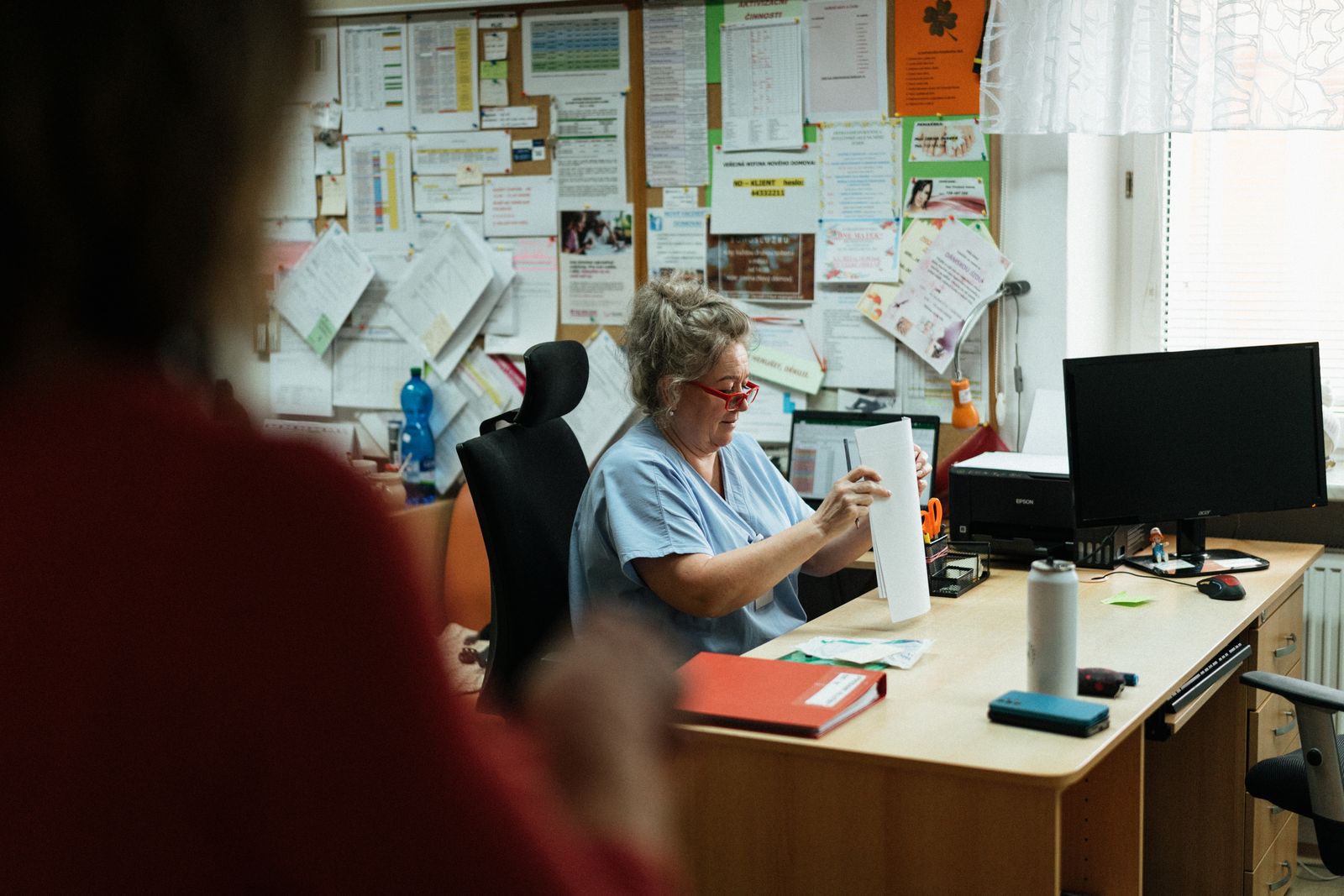
She'd gone through three councils' assessment forms with a pink highlighter, marking every place they contradicted each other, and there was a lot of pink.
I spent part of last week with her, a regional manager trying to keep one care group's standards straight across all three areas, in an office above a parade of shops with the radiator ticking away like it was counting something. The printouts sat side by side on the desk. Different scoring, different thresholds, different people to call when it went wrong.
So when the headline came through this morning that nobody is in charge of adult social care in England, she was probably the least surprised person in the country.
What did the Casey Commission's research actually find?
Research by the Nuffield Trust and the Institute for Government, commissioned by Baroness Casey's Independent Commission on Adult Social Care, found that England has no clear system leadership for adult social care. Compared with France, Germany and Japan, the system grew through ad hoc change, which has left wide variation in access, oversight and funding. Assessment processes and support levels differ from one local authority area to the next.
Baroness Casey's message to a conference in Liverpool is that successive governments have been asleep at the wheel, and The Carehome Environment's report on the research sets out the detail.
A few numbers stood out to me. The same report puts the workforce at more than 1.5 million care workers, employed by around 19,000 organisations. England is also the only UK nation without a mandatory register of care workers.
And people who pay for their own care pay, on average, 40% more for the same services than people whose care is funded by the council, according to the Nuffield Trust and Institute for Government research.
None of that is new to anyone who works in the sector, if I'm honest. What's new is having it written down by people the government has asked to fix it.
Why does it matter to a care provider that nobody is in charge?
Because the job of holding standards together doesn't disappear when the national system is fragmented. It moves down the chain to the providers, and inside the providers it lands on the people who manage across sites. When councils assess, fund and oversee care in different ways, a care group working in several areas has to absorb every one of those differences itself.
Nineteen thousand organisations, and somewhere among them is that regional manager in the office above the shops.
Every one of those employers is, in a sense, running its own little system, with its own recruitment checks, its own supervision and its own idea of what good looks like.
In a country with a care worker register, some of that assurance sits with a national body. But here it sits with whoever signs off the hire and whoever checks the standard six months later. In most groups I deal with, that is a registered manager reporting to a regional or area manager.
I'm not saying a register would fix everything, but without one the quality of the people at management level carries more of the load, not less.
Who ends up joining the dots?
Usually it's the regional manager, or the area manager or operations director in a smaller group. Job titles vary, and I've seen a head of operations do exactly the same job in a business with eight homes. They are the ones translating three councils' rules into one way of running services, and the ones a registered manager rings when a local authority's process doesn't match what head office expects.
It's a strange, unglamorous job, half diplomat and half auditor.
The best ones I know spend their week in the car between services, keeping a mental map of which commissioner wants what, and which home is quietly struggling. They rarely get thanked for it, because when they do it well nothing visible happens.
When that role is empty, or filled by someone who's out of their depth, you notice fast. Registered managers start making their own calls on how to handle each council. And practice drifts between homes in the same group. One service ends up doing something a sister service a few miles away would never do.
That drift is the provider-level version of the fragmentation the commission is describing nationally. It's just smaller, and closer to the residents.
Will reform take that pressure away any time soon?
Not quickly. The commission's final recommendations towards a National Care Service are now expected next summer, according to the same report, and recommendations are the start of a process rather than the end of one. Any change to who oversees what will take years to reach the floor of a care home.
Until then, providers are working inside the system as it is, patchy and varied by postcode, with no single body steering it.
I had a conversation with an operations director a while back (a different group, up north) who put it plainly. He'd stopped waiting for national policy to tidy things up and had started treating each local authority as a separate customer with its own rulebook. His regional managers kept the rulebooks, and it worked, mostly.
But it also meant he couldn't afford to leave one of those seats empty for long, and he knew it.
What does this mean for hiring at management level?
It means regional and area managers in care groups are doing work that, in a better-organised system, someone else might share. Elsewhere in the UK, a care worker register carries part of it. So the people you put in those roles matter more than an org chart suggests.
From the regional manager social care recruitment we've done this year, a few things stand out.
First, experience across more than one local authority, from someone who can tell you the differences without reaching for notes. Then the ability to hold registered managers to a single standard without flattening what makes each service work. And someone calm enough to handle a commissioner, an inspector and an anxious family in the same afternoon.
The last one sounds soft, but it isn't.
It's also worth thinking about depth. If one regional manager is the only person who understands how your three councils differ, that knowledge walks out the door with them.
Some of the groups we work with have started writing it down, or pairing a deputy with the regional manager on council meetings, so the map lives in more than one head. That costs very little. Replacing a regional manager who leaves with no handover, in a market where experienced people are thin on the ground, costs a lot more.
For a sense of what that role tends to involve, and what employers usually look for, there's more on hiring a regional manager in care on our site.
Joining the dots in your own patch
The commission will keep working on who should be in charge of the whole system, and that argument will run well beyond next summer. Most providers can't wait for it to finish.
Those pink-streaked printouts were the commission's findings in miniature, I think. And every council in England has its own version of that printout, and in every care group someone has to read them all and turn them into one way of doing things. Make sure you know who that person is in yours, and what happens on the day they hand in their notice.
When you're ready to think about that seat, Coburg Banks' care leadership recruitment is there.